

Cherries are small, sweet and tart reddish to maroon-coloured edible fruits that belong to the genus Prunus and family Rosaceae. It is a delicious & nutritious fruit consumed by all people across the globe irrespective of their age. Cherries provide numerous health benefits due to their antioxidant potential
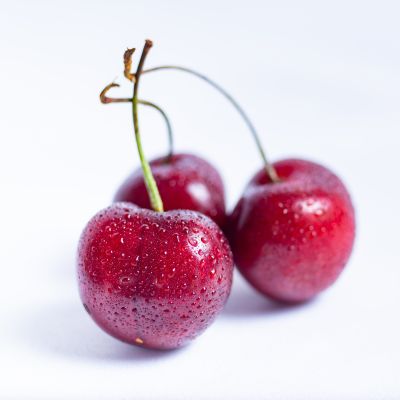
Cherries are part of various cuisines including salads, desserts, salads etc. There are various species of cherries. Commercially cherries are produced worldwide and they include both sour cherries (Prunus cerasus) and sweet cherries (P. avium). Sour cherries can be frozen or canned and used in the preparation of sauces and pastries, while sweet cherries are eaten afresh or preserved.
The cherries are fruits with a fleshy drupe (stone fruit) that is generally heart-shaped to nearly globular, measures about 2 cm (1 inch) in diameter, and varies in colour from yellow through red to nearly black.
Drupe is a fruit having thin skin, a fleshy body, a hard stone, and an inner seed. Therefore, cherry drupes are often referred to as “stone fruits” due to the presence of a hard stone in the middle.
Major commercial production of cherries occur in Europe and countries of Mediterranean region. It is also produced in America and Australia too.
History of the origin of cherries
According to historical data the Greeks were the first Europeans to start cultivating cherries and later the Romans continued to expand its production to far-flung regions.
It is believed that sweet cherries were cultivated during the ancient times in Asia Minor[ Turkey] between the Black and Caspian seas and it spread to Europe through migratory birds consuming the fruits.
It is an amazing fact that the stones of wild cherries have been found in deposits at bronze age settlements of entire Europe. It was Persians and the Romans who brought cherries into Britain many years before the 1st century AD. In Britain, cherry cultivation was promoted by the royals in the sixteenth century, particularly by Henry VIII.
In the American subcontinent, Massachusetts colonists planted the first sour cherry, ‘Kentish Red’, when they migrated to the region.
Nutritional value of cherries
Cherries are nutritious fruits packed with several kinds of nutrients vital to the body.
Sweet cherries contain 82% water, 16% carbohydrates, 1% protein, and negligible amount of fat. It is also enriched with vitamin C. Sour cherries contain more vitamin C and beta carotenes having antioxidant properties. They are good source of fibers also.
Health benefits of cherries
- Fruits with low calories
The cherries are highly recommended fruits with relatively low caloric content and can be consumed even by obese people in moderate doses.
- Rich source of antioxidants
Cherries contain polyphenols and vitamin C having anti-oxidant properties. Chiefly sweet cherries, are enriched with anthocyanins, quercetin, hydroxycinnamates, potassium, fiber, vitamin C & carotenoids.
Cherries prevent cancers, cardiovascular disease, diabetes, inflammatory diseases, and Alzheimer’s disease most probably due to their high antioxidant activity.
Cyanidin-3-glucoside and cyanidine-3-rutinoside are the major anthocyanins in cherries.
- Improves mental health & brain health
Cherries are abundant source of tryphtophan amino acid & neurotransmitter precursors for brain health. The cherries contain tryptophan, serotonin, and melatonin. Tryptophan is the precursor for neurotransmitters controlling mood.
- Anti-inflammatory properties
Cherries may reduce the risk of several chronic inflammatory diseases including, arthritis. Polyphenols, melatonin, carotenoids, and vitamins E and C all contribute to the antioxidant and anti-inflammatory properties of cherries.
- Helps to achieve sound sleep
Insomnia or sleeplessness is a common problem in this digital era. Research studies state that consumption of cherries may help to improve sleep.
- Cherries may improve cognitive function
- Some animal and cell culture studies show that cherries improve cognitive function. Further studies are required to confirm the potential to enhance the cognitive function and mental abilities in humans.
- Reduces muscle pains
Muscle aches are common after strenuous exercise. Exercise-induced muscle damage may lead to reduced muscle function from mechanical and immune stressors. This stress is mainly due to inflammation and increased oxidative stress. Studies point out that daily consumption of cherries may attenuate inflammatory and oxidative responses to exercise induced muscle damage.
- Reduces hypertension
Cherries can also reduce high blood pressure.
Safety &caution
The cherry kernels are toxic as they contain the compound amygdalin. One can reach the the inner kernal part of cherries while chewing or breaking the hard-shelled cherry pits, which contain amygdalin. It is a chemical that releases the toxic compound hydrogen cyanide when ingested.
How to include cherries in your diet?
Cherries are delicious fruits that could be included as part of various types of desserts, salads and smoothies.
- In salads
- Include in smoothies with berry
- prepare chicken salad with cherries
- Cherry puddings
- Include in almond and banana smoothie
- Cherry pan cake
- Coconut cherry smoothie
References
References for further reading
- https://www.britannica.com/plant/cherry
- https://pubmed.ncbi.nlm.nih.gov/21229414/
- https://pubmed.ncbi.nlm.nih.gov/22553424/
- https://pubmed.ncbi.nlm.nih.gov/21229414/