
Ikat is a fabric pattern of South Asia since many centuries. It is a sought after fabric art which has achieved great popularity worldwide since ancient times.
History of ikat
The word “Ikat” means bind in Malayo -polynesian languages.
Ikat weaving traditions can be divided into two groups
The first one is weaving among Daic speaking people of Vietnam hanoic. The second group of ikat fabric art tradition belongs to Austonesian people of Indonesia, Philippines, Malaysia. According to some sources Ikat takes origin from the land of Indonesia from there its glory spread to faraway lands. It is believed that another group of Ikat weaving community were residing independently in India, Japan and Central Asia, America in the same period of time.
How does ikat fabric art processing happen?
Ikat is a complicated technique involving labour and patience. In ikat weaving the resist is formed by binding yarns together with a tight wrap in the chosen pattern. Then these yarns are dyed. The bindings may then be altered to create a new pattern and the yarns dyed again with a different colour.
This process is repeated several times to create beautiful and elaborate patterns. As soon as dyeing process is finished the bindings are removed and yarns are woven into cloths.
There is another form of resist dyeing technique [ tie-dye and batik] where the resist is applied to the woven cloth.
In ikat the resist application happens before the yarns are woven into cloths. That makes the difference.
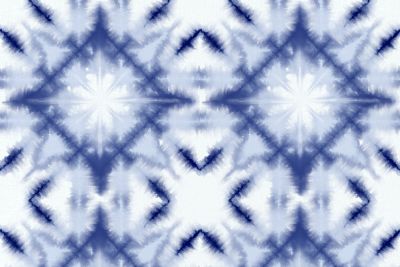
It is curious to note that in ikat both fabric faces are patterned.
There are different types of ikat dyeing:
In warp ikat or weft ikat either these yarns are dyed .
In double ikat both warp and weft yarns are dyed.
Ikat textiles may have a blurriness to the design and it might be due to the laborious work associated with weaving and dyeing. However, the pattern comes out perfectly in the finished cloth. Efficient craftsmen can mitigate the blurriness considerably using finer yarns.
However, the blurriness that is so characteristic of ikat is often prized by textile collectors. Ikat is listed among expensive ethnic fabric craft as the making is so laborious and time consuming.
Warp type of ikat seems to be originated in Neolithic weaving traditions and it is an ancient craft rooted in Asia. In India, Ikat dying technology has been present for thousands of years.
Ikat- trending fabric of urban populations
Ikat processed garments such as saree and kurtis are in demand in India and abroad along with bedsheets, door screens, and towels made in ikat art. The price of ikat made garments increases depending on the material [ silk, mul cotton etc] used for crafting this art.