

Indian subcontinent has several renowned trees for worshipping which are considered sacred. The list of sacred trees of India chiefly includes Banyan tree and Peepal.
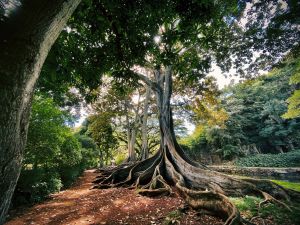
Trees are symbolically connected with tradition and culture in various geographical regions of the world since time immemorial. The concept of linking trees with holiness or divinity and categorizing them as sacred trees is intricately connected to Indian as well as South East Asian cultures.
Indian subcontinent and countries like Japan, Korea also have this deep-rooted linkage with trees. The trees have merged intimately with myths and legends of the region and rituals are performed to worship trees in some of these hamlets for many centuries.
The tradition & practice of worshipping trees connecting with the religious landscape has been noted since ancient times. Hinduism, Jainism and Buddhism has religious linkage with trees.
Indian subcontinent has several renowned trees for worshipping which are considered sacred. The list of trees chiefly includes Banyan tree and Peepal. Other sacred trees include Neem, Ashoka,Kadamba, Parijata,Sandal wood , fig tree etc.
Trees are symbolic representation of knowledge according to various cultures of India. Banyan tree is connected with permanent wisdom of hermit life and enlightenment.
Various religious texts and scriptures of Hinduism, Buddhism and Jainism has mentions about sacred trees and environment. The Hindu text Matsyapurana has Sanskrit hymns which illustrates the reverence paid to ecology in the ancient era.The excerpt from Matsyapurana goes like this:
“A pond equals ten wells, a reservoir equals ten ponds, while a son equals ten reservoirs and a tree equals ten sons”.
According to Vedic literature many trees including Banyan tree, figs, khejri, teak,silk cotton were integral part various vedic rituals.
In Sikhism Jujube tree is considered as a sacred tree capable of removing all woes and sufferings, particularly the jujube tree situated near Harmandir sahib complex, Amritsar.
Banyan tree [Ficus benghalensis]
Banyan tree is worshipped as a symbol of longevity, connectedness, life’s stability and strength. This tree is a connecting link between generations due to its long years of survival or lifespan. The tree has witnessed many centuries, attaining giant aerial roots over the years and remains symbolic of growth, connectedness, stability and longevity.
Banyan tree is regarded as the symbol of Trimurti- Lord Brahma, Vishnu and Shiva according to Hinduism and it is worshipped very fervently in the subcontinent. The tree is considered as immortal as per the vedic traditions.
Banyan tree has gained significance beyond the spiritual realm and it is often regarded as a symbol of fertility, longevity and stability gathering the sobriquet tree of life. It is the national tree of India.
Indian subcontinent has numerous centuries old Banyan trees and Sagar in Madhya Pradesh has a Banyan tree which is believed to be 5000years old.
Ficus benghalensis or Banyan tree is an evergreen tree with wide spreading crown of green foliage and grows to a height of 20-30 meters. It is an epiphyte growing on the stem or branch of another tree and as it grows over the years numerous aerial roots are generated and these root hanging down to the earth touching the soil. Eventually these roots thicken and imparts strength and stability.
Peepal tree [ Ficus religiosa]
Peepal is known as Bodhi tree because it is under a Peepal tree The great Buddha achieved enlightenment. The tree has religious significance not only in Buddhism but also in Hinduism and Jainism. The sacred fig is the tree of meditation and has given utmost significance in Indian state Odisha, Bihar and Haryana as the state tree.
Ficus religiosa is a seasonal deciduous semi evergreen tree growing into the height of above 30m and trunk diameter up to 3 meters. Ficus is native to India and its neighboring countries like Nepal , Bhutan and Bangladesh etc. It grows in a wide variety of soils having good drainage for water. Ficus grows well in temperature range0-35 degree Celsius. It gross well in a wide variety of climates including tropical rain forest climate and tropical monsoon climate.
The stories Sacred trees of India are innumerable and are infused intricately with the religion, tradition and culture of this land and it imparts fervent hues to the cultural heritage as well as lives of people of the subcontinent since antiquity.
written by dr Sanjana p
Image courtesy:https://www.freepik.com/free-photo/exotic-tree-with-roots-ground-middle-beautiful-forest_9283112.htm#fromView=search&page=1&position=8&uuid=e256ad2a-0da1-4265-9936-bd12aef12e13&query=+ficus++trees+with+aerial+roots