

Tag: indiheritage

  • Sacred trees of India

    Indian subcontinent has several renowned trees for worshipping which are considered sacred. The list of sacred trees of India chiefly includes Banyan tree and Peepal.
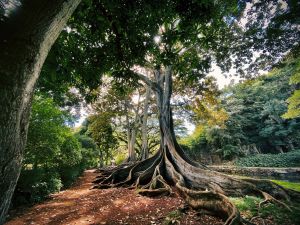
      Trees are symbolically connected with tradition and culture in various geographical regions of the world since time immemorial. The concept of linking trees with holiness or divinity and categorizing them as sacred trees is intricately connected to Indian as well as South East Asian cultures.

    Indian subcontinent and countries like Japan, Korea also have this deep-rooted linkage with trees. The trees have merged intimately with myths and legends of the region and rituals are performed to worship trees in some of these hamlets for many centuries.

    The tradition & practice of worshipping trees connecting with the religious landscape has been noted since ancient times. Hinduism, Jainism and Buddhism has religious linkage with trees.

     Indian subcontinent has several renowned trees for worshipping which are considered sacred. The list of trees chiefly includes Banyan tree and Peepal. Other sacred trees include Neem, Ashoka,Kadamba, Parijata,Sandal wood , fig tree etc.

    Trees are symbolic representation of knowledge according to various cultures of India. Banyan tree is connected with permanent wisdom of hermit life and enlightenment.

     Various religious texts and scriptures of Hinduism, Buddhism and Jainism has mentions about sacred trees and environment. The Hindu text Matsyapurana has Sanskrit hymns which illustrates the reverence paid to ecology in the ancient era.The excerpt from Matsyapurana goes like this:

    “A pond equals ten wells, a reservoir equals ten ponds, while a son equals ten reservoirs and a tree equals ten sons”.

    According to Vedic literature many trees including Banyan tree, figs, khejri, teak,silk cotton were integral part various vedic rituals.

    In Sikhism Jujube tree is considered as a sacred tree capable of removing all woes and sufferings, particularly the jujube tree situated near Harmandir sahib complex, Amritsar.

    Banyan tree [Ficus benghalensis]

    Banyan tree is worshipped as a symbol of longevity, connectedness, life’s stability and strength. This tree is a connecting link between generations due to its long years of survival or lifespan. The tree has witnessed many centuries, attaining giant aerial roots over the years and remains symbolic of growth, connectedness, stability and longevity.

    Banyan tree is  regarded as the symbol of Trimurti- Lord Brahma, Vishnu and Shiva according to Hinduism and it is worshipped very fervently in the subcontinent. The tree is considered as immortal as per the vedic traditions.

     Banyan tree has gained significance beyond the spiritual realm and it is often regarded as a symbol of fertility, longevity and stability gathering the sobriquet tree of life. It is the national tree of India.

     Indian subcontinent has numerous centuries old Banyan trees and Sagar in Madhya Pradesh has a Banyan tree which is believed to be 5000years old.

    Ficus benghalensis or Banyan tree is an evergreen tree with wide spreading crown of green foliage and grows to a height of 20-30 meters. It is an epiphyte growing on the stem or branch of another tree and as it grows over the years numerous aerial roots are generated and these root hanging down to the earth touching the soil. Eventually these roots thicken and imparts strength and stability.

    Peepal tree [ Ficus religiosa]

    Peepal is known as Bodhi tree because it is under a Peepal tree The great Buddha achieved enlightenment. The tree has religious significance not only in Buddhism but also in Hinduism and Jainism.  The sacred fig is the tree of meditation and has given utmost significance in Indian state Odisha, Bihar and Haryana as the state tree.

    Ficus religiosa is a seasonal deciduous semi evergreen tree growing into the height of above 30m and trunk diameter up to 3 meters. Ficus is native to India and its neighboring countries like Nepal , Bhutan and Bangladesh etc. It grows in a wide variety of soils having good drainage for water. Ficus grows well in temperature range0-35 degree Celsius. It gross well in a wide variety of climates including tropical rain forest climate and tropical monsoon climate.

    The stories Sacred trees of India are innumerable and are infused intricately with the religion, tradition and culture of this land and it imparts fervent hues to the cultural heritage as well as lives of people of the subcontinent since antiquity.

    written by dr Sanjana p

    Image courtesy:https://www.freepik.com/free-photo/exotic-tree-with-roots-ground-middle-beautiful-forest_9283112.htm#fromView=search&page=1&position=8&uuid=e256ad2a-0da1-4265-9936-bd12aef12e13&query=+ficus++trees+with+aerial+roots


  • The shell of tranquility

    Stands alone in the arid deserts of scorching sun,

    And sustained alone in the abyss of deep blue ocean,

    within the shell of tranquility,

    In the chaos conquering the will,

    In the challenges contracting the footsteps,

    In the deluge of despondent days.

    None can trespass the shell

    No annoying calls or invitations,

    No humiliations.

    No love letters,

    But peace and harmony with self

    Enlivened here, sustained here .

    The shell of tranquility

    Sustains the serenity forever,

    as a fortress with sentries

     Invisible to the sight of the bustling world

    But to the insight!

     The indomitable will

    Strengthening the ramparts of the fort

     for decades fallen with the autumn foliage

    In the nights frozen & days wilted.

    The days and nights in long years

    Swirled inside like a snail,

    The sunshine and moonlight knocked often at the rooftop

     Adoring the princess of tranquility within the shell.

    In the dusky twilights of miseries

    Universe sent a breezy wind of Autumn night

     To enliven her leisure

    Kind enough to grace her virtues

    within the shell of tranquility.

    copyright dr sanjana p souparnika

    image courtesy freepik

  • THE FEATHERS OF LOVE

    Sobbing of the endless sky,

    On hazy grey avenues,

     As the clouds of Aashaada(rainy month) ,

    Stand gloomy without any down pour as your love.

    With the chirping birds nesting in your solitude,

    I too shed feathers of love sometimes,

    Breaking the silence of your tranquillity.

    Perchance, I am that incomplete poem,

    Have been writing since many decades,

     In the drizzles poured &pattered the bygone years….

    Or the portraits drawn by the wet clouds of hazy sky,

     On the wavy water lines, on my half-closed windows….

    The rainy clouds & downpours visited again and again

     in the minds of mankind since time immemorial,

    For years strolled past, spanning over the seasons.

     With no beginning or ending in the time scale ever,

    With no disparities of time and space.

    Behold, the ethereal clouds

    Standing on my boundless sky,

    With no downpour yet.

    My holy, fiery blazing clouds of sky,

    And my wondrous eyes

    Amazed at them forever!

    Let me stand at this lonesome corner of sky for a while,

    Listening the rhythm of drizzle,

    Merging my soul into the abyss of oblivion.

    Sinking into the dreams of forest green moonlights,

    Somewhere fireflies glittered

     Knowing their lights are ephemeral

    Unlike the milky moonlight.

    Yet, glowing and gleaming since time immemorial

    Enchanting the world,

    Delighting the souls.

    Fireflies of forest greens

    imparts the dismayed souls

    the great lesson of living the moment

    Enlightening the world till the breath bid adieu

    shedding the feathers of love forever!

    Copyright Dr. Sanjana p . Souparnika

  • Thalagunda – Pranaveswara temple a connecting link to the history of south India

    This image has an empty alt attribute; its file name thalagunda temple-1.jpg

    Praveswara temple, Thalagunda in Karnataka is an ancient shiva temple of Kadamba dynasty , a monument protected monument by Archeological Survey of India[ASI] due to its historical significance.

    Thalagunda,karnataka

    Thalagunda is a village in the Shikaripura taluk of Shivamogga district in the state of Karnataka, India. The village has been referred as Sthala-Kundura, Sthana-Kundur and Sthana-kunja-pura during ancient period. This hamlet is situated about 45 km from Banavasi, 20 km from Soraba and 7 km from Siralkoppa town.

    There are many ancient temples in Thalagunda village including pranaveshvara, gangaadhareshvara, trineetra and veerabhadra temples. Praveswara temple is a protected monument by Archeological Survey of India[ASI] due to its historical significance.

    According to the inscription found in the pillar of pranaveswara temple, it can be assumed that the temple was worshiped by earlier rulers including the Satakarnis. The temple dates back to the Satavahana period. However the current findings of architecture denotes that it is not of the Satavahana period but of the early Kadambas although explorations around the temple premises had revealed brick structure of the Satavahana period.

    Pranaveswara temple

      The temple is a small square building consisting of a garbhagriha and a sukanasi. There is a huge Shivalinga inside the sanctum. The garbha-griha doorway jambs are carved out of Kadamba inscription stones, the entrance doorway construction style denotes that it is of a later period, perhaps of the eleventh century CE.

    Thalagunda inscription pillar

    The Talagunda pillar inscription of Kakusthavarman is a well known epigraphic record in Sanskrit found in the ruined pranaveswara temple. The pillar is located in front of the Pranavalingeshwara temple.

    The inscriptions are engraved on hard grey granite and dated to between 455 and 470 CE. It throws light into the history of Kadamba dynasty and the reign of king Śāntivarma in northwest Karnataka.

    The pillar is 1.635 metres (5.36 ft) high with a 0.4 metres (1.3 ft) square top. It is octagonal shaft that slightly tapers and narrows as it goes up. The width of the octagonal face is 0.178 metres (0.58 ft). The inscription is found on all faces, but on 7 of the 8 faces, it consists of two vertical lines that start at the bottom of the pillar. On the eighth face, we can find just one short line.

    The inscription consists of 34 poetic verses that respect the chanda rules of Sanskrit. It is the earliest epigraphical evidence found in Karnataka about the existence of a Hindu temple dedicated to Shiva in Talagunda, the construction of a temple water tank, and the practice of worshipping the Shiva Linga before about 450 CE.

    The inscription unravels the glory of Kanchipuram as a center (ghatika) for advanced studies in ancient India, where the already learned Brahmin Mayurasarman from Talagunda goes with his counsellor to study the whole Veda. It also throws light into the cultural values and customs prevailed in the 5th-century India with the mention of “music” and goddess of wealth (Lakshmi) and speaks about the practice of marriage between north Indian and South Indian empires.

    How to reach Thalagunda ?

    The nearest railway station is Shivamoga .You may reach Manglore or Bangluru by flight and may reach Shivamoga by train or bus service. Approximately a one and half hour journey from Shivamoga by cab may help you reach Thalagunda[77.5km].

    References