

Tag: indian trees

  • Sacred trees of India

    Indian subcontinent has several renowned trees for worshipping which are considered sacred. The list of sacred trees of India chiefly includes Banyan tree and Peepal.
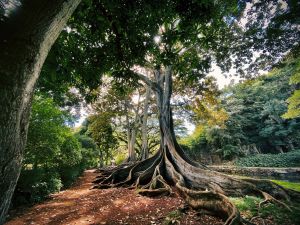
      Trees are symbolically connected with tradition and culture in various geographical regions of the world since time immemorial. The concept of linking trees with holiness or divinity and categorizing them as sacred trees is intricately connected to Indian as well as South East Asian cultures.

    Indian subcontinent and countries like Japan, Korea also have this deep-rooted linkage with trees. The trees have merged intimately with myths and legends of the region and rituals are performed to worship trees in some of these hamlets for many centuries.

    The tradition & practice of worshipping trees connecting with the religious landscape has been noted since ancient times. Hinduism, Jainism and Buddhism has religious linkage with trees.

     Indian subcontinent has several renowned trees for worshipping which are considered sacred. The list of trees chiefly includes Banyan tree and Peepal. Other sacred trees include Neem, Ashoka,Kadamba, Parijata,Sandal wood , fig tree etc.

    Trees are symbolic representation of knowledge according to various cultures of India. Banyan tree is connected with permanent wisdom of hermit life and enlightenment.

     Various religious texts and scriptures of Hinduism, Buddhism and Jainism has mentions about sacred trees and environment. The Hindu text Matsyapurana has Sanskrit hymns which illustrates the reverence paid to ecology in the ancient era.The excerpt from Matsyapurana goes like this:

    “A pond equals ten wells, a reservoir equals ten ponds, while a son equals ten reservoirs and a tree equals ten sons”.

    According to Vedic literature many trees including Banyan tree, figs, khejri, teak,silk cotton were integral part various vedic rituals.

    In Sikhism Jujube tree is considered as a sacred tree capable of removing all woes and sufferings, particularly the jujube tree situated near Harmandir sahib complex, Amritsar.

    Banyan tree [Ficus benghalensis]

    Banyan tree is worshipped as a symbol of longevity, connectedness, life’s stability and strength. This tree is a connecting link between generations due to its long years of survival or lifespan. The tree has witnessed many centuries, attaining giant aerial roots over the years and remains symbolic of growth, connectedness, stability and longevity.

    Banyan tree is  regarded as the symbol of Trimurti- Lord Brahma, Vishnu and Shiva according to Hinduism and it is worshipped very fervently in the subcontinent. The tree is considered as immortal as per the vedic traditions.

     Banyan tree has gained significance beyond the spiritual realm and it is often regarded as a symbol of fertility, longevity and stability gathering the sobriquet tree of life. It is the national tree of India.

     Indian subcontinent has numerous centuries old Banyan trees and Sagar in Madhya Pradesh has a Banyan tree which is believed to be 5000years old.

    Ficus benghalensis or Banyan tree is an evergreen tree with wide spreading crown of green foliage and grows to a height of 20-30 meters. It is an epiphyte growing on the stem or branch of another tree and as it grows over the years numerous aerial roots are generated and these root hanging down to the earth touching the soil. Eventually these roots thicken and imparts strength and stability.

    Peepal tree [ Ficus religiosa]

    Peepal is known as Bodhi tree because it is under a Peepal tree The great Buddha achieved enlightenment. The tree has religious significance not only in Buddhism but also in Hinduism and Jainism.  The sacred fig is the tree of meditation and has given utmost significance in Indian state Odisha, Bihar and Haryana as the state tree.

    Ficus religiosa is a seasonal deciduous semi evergreen tree growing into the height of above 30m and trunk diameter up to 3 meters. Ficus is native to India and its neighboring countries like Nepal , Bhutan and Bangladesh etc. It grows in a wide variety of soils having good drainage for water. Ficus grows well in temperature range0-35 degree Celsius. It gross well in a wide variety of climates including tropical rain forest climate and tropical monsoon climate.

    The stories Sacred trees of India are innumerable and are infused intricately with the religion, tradition and culture of this land and it imparts fervent hues to the cultural heritage as well as lives of people of the subcontinent since antiquity.

    written by dr Sanjana p

    Image courtesy:https://www.freepik.com/free-photo/exotic-tree-with-roots-ground-middle-beautiful-forest_9283112.htm#fromView=search&page=1&position=8&uuid=e256ad2a-0da1-4265-9936-bd12aef12e13&query=+ficus++trees+with+aerial+roots

  •  The cultural & ecological significance of Khejri tree

     Khejri tree is one of the most beloved trees of Indian subcontinent, with its distinctive leaves and small yellow flowers and the tree grows in arid, dry climate with tolerance to adverse weather.

    Prosopis cineraria is the scientific name of this special tree which is intricately linked to the culture and traditions of Indian subcontinent since ancient times. Prosopis belongs to the pea family, Fabaceae.

    Prosopis cineraria is the state tree of Rajasthan where it is known as khejri. This tree is known by various names in different parts of the country. In Western Uttar Pradesh it is known as chhonkara and inTelangana  it is known as jammi. It is well-known in Madhya Pradesh& Maharashtra as Shami. Gujrati people of India knows the tree as khijro.

    Its adaptability to arid & dry climatic conditions has imparted it ecological significance as the preserver of soil and biodiversity sustainability.

    Khejri -the star of deserts all over the globe

     Prosopis cineraria [khejri tree] is native to arid portions of Western Asia and the Indian Subcontinent. It is cultivated in Afghanistan, Bahrain, Iran, India, Oman, Pakistan, Saudi Arabia, the United Arab Emirates, and Yemen. It is the national tree of the United Arab Emirates.

    The story of human sacrifice for khejri tree & the chipco movement

    In 1730 AD, the village of Khejarli near Jodhpur in Rajasthan witnessed a scene of violent & vehement environmental confrontation. Maharaja Abhai Singh of Marwar had ordered to cut khejri trees of the region to build a new palace there. A family resided in that region including Amrita Devi and her three young daughters gave their lives in an attempt to protect some khejri trees. This incident led to widespread protest and resentment and later turned into a massive movement in which 363 people were killed in the attempt to save the trees. In hindsight, this tragic incident compels us to have a look at the cultural significance of the tree in the history of Indian landscapes & vegetations.  Khejri was part of their ethnic culture and lives rather than the environmental significance the tree connotes currently.

     Later in the 1970s, the memory of this sacrifice led to the start of the Chipko movement in India which raise voice against cutting trees indiscriminately.

    Kejri – A sacred linking with the myth

     The Indian epic Mahabharata narrates the story of the Pandavas spent their thirteenth year of exile in disguise in the kingdom of Virata. Before entering the kingdom of Virata, they hung their celestial weapons on the khejri [Shami]tree for safekeeping for a year. When they returned after a year, they found their weapons safe in the branches of the Shami tree. It is narrated in the epic that before taking their weapons from the Shami tree, the Pandavas worshipped the tree and thanked it for keeping their weapons safe. It is curious to know that in Indian subcontinent every landscape and vegetation has a sacred linking with divinity as well as myths. Khejri is one of the such instances of trees being part of the culture and traditions of a spiritually inclined ancient society.

    Khejri tree -Botanical description

    The tree is found in extremely arid conditions, with rainfall as low as 15 cm (5.9 in) annually. Prosopis cineraria is a small tree, ranging in height from 3–5 m (9.8–16.4 ft). The leaves are bipinnate, with seven to fourteen leaflets on each of one to three pinnae. Branches are thorned along the internodes. Flowers are small and creamy-yellow and followed by seeds in pods.

    The plant has tolerance for highly alkaline and saline environments and thrive in these localities also.

    Kejri tree- A cultural link with Dussehra

    The tree is revered by Hindu community in Inda and it is intricately connected with Dusshera festival. On the tenth day of the Dasara Festival the tree has some special significance.

    In the Deccan region of India, as part of the tenth-day ritual of Dussehra, the marathas used to shoot arrows onto the crown of the khejri tree and gather the falling leaves into their turbans.

    Mysore Dasara &Banni [ kejri] tree

    According to historical references, Prosopis cineraria is known as the Banni mara, and holds a special place in the Mysore Dasara, where it’s worshipped on the Vijay-dashami day.

    Conservation efforts for the Khejri Tree focus on promoting sustainable land management practices, afforestation initiatives, and the preservation of natural habitats. Protection and restoration of Khejri-dominated ecosystems contribute to the maintenance of biodiversity and sustainable use of this resilient species.

    Khejri – Ecological warrior against soil erosion and climate crisis

    Currently the entire world is grappled with climate crisis as the aftereffect of global warming. At another end landslides and soil erosion are continuously morphing the landscape of our habitat and ecosystem. In the wake of these grave scenarios, Khejri tree due to its adaptability to adverse weather conditions and survival in arid regions helps to mitigate the impact of climate crisis and soil erosion indirectly. Therefore we can call the plant as an ecological warrior which preserve the ecosystem with its deep roots and leaves.

    As the Chipco movement advocates for preservation of trees, let us Embrace the trees , stop cutting and felling them down as long as no direct imminent threat of trees falling and endanger human lives under torrential rain and tempests. The term “Chipko” means “to hug” or “to embrace”. Let us embrace this tree and many others of its kind into human culture as well as lives to preserve our ecosystem and delve into our roots to imbibe the good practices of ancient wisdom.

    Written by Dr. Sanjana .P. Souparnika

    References for further reading