

Buddhist art of Indian subcontinent (c. 150 BCE – c. 500 CE) has imbibed the art of other religions & geographical regions due to foreign influence overtime. Sanchi, Bharhut and Amaravati are embodiments of Buddhist art forms. Buddhist stupas and sculptures were built during the reign of various dynasties who ruled the subcontinent
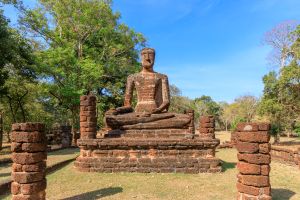
Buddhism in Indian art an overview
Indian art forms are huge in number and it encompasses painting, sculpture, pottery, and textile arts. When you mention Indian arts it includes the art forms of Indian subcontinent existed since many centuries. Geographically, the art spans a wide area encompassing the current India, Pakistan, Bangladesh, Sri Lanka, Nepal, Bhutan, and at times eastern Afghanistan.
The Indian art forms are intricately crosslinked with the religions of the subcontinent. Hinduism, Buddhism, Jainism, Sikhism and Islam have been depicted in the art marvellously.
Foreign influence on Indian art can be seen in various art forms of Indian subcontinent. Central Asia, Iran, and Europe had tremendous influence in developing Indian art due to overseas trade relations with this land.
Sanchi, Bharhut and Amaravati are embodiments of Buddhist art forms with statues and stupas. In these sites stupas are surrounded by ceremonial fences with four profusely carved toranas or ornamental gateways facing the cardinal directions. The Buddhist art monuments are built in stone, though clearly adopting forms developed in wood. Mathura was the most important centre in this development, which applied to Hindu and Jain art as well as Buddhist.
The caves at Ajanta, Karle, Bhaja etc. contain ancient sculptures. Buddhists gave emphasis on making statues of Buddha, influenced by Hindu and Jain religious figurative art.
Greko-Buddhist influence
The Greko-Buddhist influence on art was evident after the conquests of Alexander the Great. This fusion developed in the far north-west of India, especially Gandhara in modern Afghanistan and Pakistan.
BuddhistArt during reign of Kushana empire
The Indian Kushan Empire who reigned northern India had built large statues that were portraits of the royal dynasty
Kushan Empire (c. 30 CE – c. 375 CE) was a syncretic empire in central and southern Asia, From 127 to 151 CE,[ Gandhara] reached the zenith of its glory under the reign of Kanishka. In this period, Kushan art inherited the Greko-Buddhist art.
Mahayana Buddhism flourished, and the depictions of Buddha as a human form first appeared in art wearing a monk’s robe and a long length of cloth draped over the left shoulder and around the body.
The distinctive feature of Gandharan art is its connection to naturalism of Hellenistic art. The naturalistic features seen in Gandharan sculptures include the three-dimensional treatment of the drapery, with unregularized folds that are in realistic patterns of random shape and thickness.
The physical form of the Buddha and his bodhisattvas are well-defined, solid, and muscular, with swelling chests, arms, and abdomens in these art works.
Buddhist Art during Shunga dynasty’s reign
The Buddhist stupa from the Shunga Dynasty is The Great Stupa at Sanchi, believed to be founded by the Mauryan emperor Ashoka c. 273 BCE – 232 BCE during the Maurya Empire. The Great Stupa was enlarged to its present diameter of 120 feet, covered with a stone casing, topped with a balcony and umbrella, and encircled with a stone railing during the Shunga Dynasty c. 150 BCE – 50 BCE.
In addition to architecture, another significant art form of the Shunga Dynasty is the elaborately moulded terracotta plaques. As seen in previous examples from the Mauryan Empire, a style in which surface detail, nudity, and sensuality is continued in the terracotta plaques of the Shunga Dynasty. The most common figural representations seen on these plaques are women, probably goddesses, who are mostly shown as bare-chested and wearing elaborate headdresses.
Buddhist Art during Shatha vahana dynasty rule
Satavahana dynasty (c. 1st/3rd century BCE – c. 3rd century CE) built Amaravati Stupa, the Karla Caves, and the first phase of the Ajanta Caves.
Relief sculptures of Buddhist figures and epigraphs written in Brahmi characters are often found in divine places specific to Buddhism.
To celebrate the divine, Satavahana people also built stone images as the decoration in Buddhist architectures.
Furthermore, the Satavahanas coins made primarily in copper, lead and potin depicts arts of the period.
Gupta art (c. 320 CE – c. 550 CE) of Buddhism
The Gupta period is the golden era for north Indian art and it is found in the Ajanta Caves; the surviving works are chiefly religious sculptures. The period witnessed the emergence of the iconic carved stone deity in Hindu art, as well as the Buddha-figure and Jain tirthankara figures.
The prominent centres of sculpture were Mathura Sarnath, and Gandhara, perhaps the last the centre of Greco-Buddhist art.
Buddhist art in current India
Most of the Buddhist art forms as sculptures, stupas, paintings still exist in Indian subcontinent although a few are in a dilapidated condition due to adverse climate, invasions and wars. In current India one can find Buddhist monuments in various states.
- Bihar: Mahabodhi Temple (Bodh Gaya), Nalanda University ruins, Rajgir, Vaishali, Kesaria Stupa.
- Uttar Pradesh (UP): Sarnath (Dhamek Stupa), Kushinagar (Parinirvana Stupa), Sravasti, Piprahwa.
- Maharashtra: Ajanta & Ellora Caves, Karla Caves, Deekshabhoomi (Nagpur).
- Madhya Pradesh (MP): Sanchi Stupa, Bharhut.
- Odisha: Lalitgiri, Ratnagiri, Udayagiri, Dhauli.
- Ladakh: Thiksey, Hemis, Alchi Monasteries.
- Sikkim: Rumtek, Enchey, Pemayangtse Monasteries.
- Himachal Pradesh: Tabo, Kye Monasteries, Dharamshala.
- Andhra Pradesh: Amaravati, Nagarjunakonda, Bhattiprolu.
- Tamil Nadu: Nagapattinam, Kanchi.
- Karnataka: Bylakuppe (Sera Monastery).
- Telangana: Nelakondapalli, Phanigiri.
- Arunachal Pradesh: Tawang Monastery.
- West Bengal: Bharatpur Buddhist Monastery Complex.
These monuments of art at various historical destinations may provide any art afficianados or visitors an elaborate account of the emergence and growth of Buddhism in the subcontinent and how its ideologies rooted in this land. The history Buddhism and art is inseparably merged with the geopolitical history of Indian subcontinent and visiting these destinations may enkindle the principles of Ahimsa and nonviolence in the traveller’s mind and soul along with the aesthetic and visual appeal the monumental arts can offer.