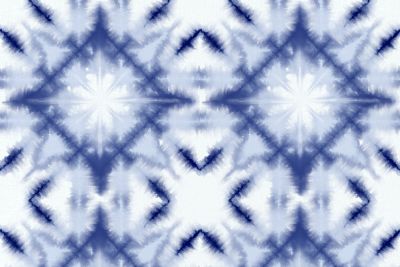
Ikat is a fabric pattern of South Asia since many centuries. It is a sought after fabric art which has achieved great popularity worldwide since ancient times.
History of ikat
The word “Ikat” means bind in Malayo -polynesian languages.
Ikat weaving traditions can be divided into two groups
The first one is weaving among Daic speaking people of Vietnam hanoic. The second group of ikat fabric art tradition belongs to Austonesian people of Indonesia, Philippines, Malaysia. According to some sources Ikat takes origin from the land of Indonesia from there its glory spread to faraway lands. It is believed that another group of Ikat weaving community were residing independently in India, Japan and Central Asia, America in the same period of time.
How does ikat fabric art processing happen?
Ikat is a complicated technique involving labour and patience. In ikat weaving the resist is formed by binding yarns together with a tight wrap in the chosen pattern. Then these yarns are dyed. The bindings may then be altered to create a new pattern and the yarns dyed again with a different colour.
This process is repeated several times to create beautiful and elaborate patterns. As soon as dyeing process is finished the bindings are removed and yarns are woven into cloths.
There is another form of resist dyeing technique [ tie-dye and batik] where the resist is applied to the woven cloth.
In ikat the resist application happens before the yarns are woven into cloths. That makes the difference.
It is curious to note that in ikat both fabric faces are patterned.
There are different types of ikat dyeing:
In warp ikat or weft ikat either these yarns are dyed .
In double ikat both warp and weft yarns are dyed.
Ikat textiles may have a blurriness to the design and it might be due to the laborious work associated with weaving and dyeing. However, the pattern comes out perfectly in the finished cloth. Efficient craftsmen can mitigate the blurriness considerably using finer yarns.
However, the blurriness that is so characteristic of ikat is often prized by textile collectors. Ikat is listed among expensive ethnic fabric craft as the making is so laborious and time consuming.
Warp type of ikat seems to be originated in Neolithic weaving traditions and it is an ancient craft rooted in Asia. In India, Ikat dying technology has been present for thousands of years.
Ikat- trending fabric of urban populations
Ikat processed garments such as saree and kurtis are in demand in India and abroad along with bedsheets, door screens, and towels made in ikat art. The price of ikat made garments increases depending on the material [ silk, mul cotton etc] used for crafting this art.
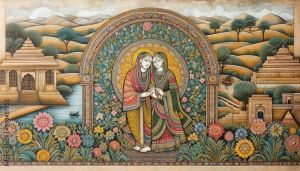
Madhubani paintings is a popular art form which has been widely used in Indian ethnic fashion for many decades. It is passionately loved by Indian fashion aficionados across the globe and fabrics and outfits with madhubani paintings are in huge demand. This ancient ethnic art originated from Madhubani district of the Mithila region of present Bihar,India. Madhubani paintings use two-dimensional imagery, and traditional colors derived from nature.
Madhubani art mostly depicts people and their intricate connection with nature along with scenes and deities from the ancient epics. This painting style is named after the Madhubani district of Bihar, India, where it originated.
It is a style of painting practiced in the Mithila region of India and Nepal and hence Madhubani art is also known as Mithila art.
Mithila painting’s themes include natural objects like the sun, the moon, and sacred plants like Tulsi along with scenes from the royal court and social events like weddings. In this art form the gaps between main figures and objects are filled by paintings of flowers, animals, birds etc. It includes geometric designs also.
The origin & style of Madhubani painting
The Madhubani art is traditionally practiced for many decades by women of Jitwarpur, Ranti and Rasidpur. The paintings were traditionally done on freshly plastered mud walls and floors of huts, but later they started doing it on cloth, handmade paper and canvas.
Madhubani paintings use traditional colors derived from nature. The pigments used for making this art include vermilion powder mixed with grounded mustard seeds for red, cow dung mixed with lampblack for greenish black, rice paste for white, Pevdi for lemon yellow, turmeric for yellow ochre, Indigo for blue, palash flower for orange, bilva leaf for green, and red clay for indian red.
Gum arabic or goat’s milk constitutes the paint’s binder. Gum arabic is used for painting on paper and goat’s milk used mainly for wall paintings.
The paint is created using natural dyes and pigments such as ochre and lampblack are used for reddish brown and black respectively.
The creation of painting is done using twigs, brushes, nib-pens, matchsticks and sometimes with fingers. Still the artists continue to utilize traditional brushes, which consist of bamboo slivers, rags, and sticks.
Madhubani painting art is still confined to specific geographical area and the skills have been passed on to generations through centuries. However, the content and the style of Madhubani painting have not transformed overtime. It has stood the test of time with its unique and exquisite style and popularity. Thus, Madhubani painting has received GI (Geographical Indication) status.
The paintings are characterized by their astounding geometrical patterns. There is also ritual content made available for particular occasions, such as birth or marriage, and festivals, such as Holi, Surya Shasti, Kali Puja, Upanayana, and Durga Puja.
Mithila art has five distinctive styles:
Bharni
Katchni
Tantrik
Godna
Kohbar
In the 1960s, Bharni and Tantrik styles of Madhubani art were predominantly created by Brahmin women in India and Nepal, focusing on religious themes and depictions of gods and goddesses.
Artists from other castes incorporated elements from their daily lives, local legends like the story of Raja Shailesh, and various symbols into their paintings.
Khobar style Madhubani
It is also known as puren , and it is traditionally painted on the wall of a Mithila wedding chamber, where a bride and groom spend their first night together. They most often depict circular motifs made up on feminized faces, and lines drawn in red and black ink. There are both Brahman and Kayastha versions of the Khobar style.
Madhubani mythological linking
Madhubani paintings also known as Mithila art has a mythological linking with epic Ramayana. It is believed that the Mahbubani painting was first created at Mithila, the birthplace of Hindu goddess Sita of Ramayana. According to the epic, Mithila is the birthplace of Sita and she was the daughter of king Janak. During the marriage rituals of Lord Ram and Sita , King Janak asked to capture the moments of marriage as paintings.
Later Madhubani painting was traditionally created by the women of various communities in the Mithila region for many centuries.
Madhubani painting -on the trajectory of growth &popularity
Deliberate and consistent efforts have been taken by many institutions in India to sustain this beautiful ancient art form. It is still practiced and kept alive in institutions spread across the Mithila region. Kalakriti in Darbhanga.
Vaidehi in Benipatti in Madhubani district and Gram Vikas Parishad in Ranti are some of the major centres of Madhubani painting which have taken taken tremendous efforts to preserve & sustain this ancient art form for generations yet to come and it is indeed awe-inspiring.
Madhubani artists have been featured in multiple museum collections and exhibitions, including a UNESCO Christmas card collection and an exhibit from San Francisco’s Asian Art Museum titled Painting is My Everything: Art From India’s Mithila Region. It denotes the global recognition this ancient art form has achieved over the years.
In contemporary times, Madhubani art has evolved into a global art form, transcending caste distinctions unlike as in the past. Artists now freely work across all five styles of Madhubani, and has gained international recognition.
Nation honouring the artisans of Midhila paintings
Madubani artists have been honoured by the government of India several times and still it is a continuing tradition. Madhubani painting received official recognition for the first time in 1969 when Sita Devi received the State award by the Government of Bihar. Later Indian government honoured her with National Award also. Mamta Devi from the village Jitwarpur also received the National Award.
Jagdamba Devi from Bhajparaul, was honoured with Padma Shri by the nation in 1975. In 1984 Ganga Devi was awarded by Padma Shri& Mahasundari Devi received the Padma Shri in 2011.