

Yoga has tremendous effects on strengthening core muscles of back &pelvis. Research studies substantiate that several yoga poses help to strengthen spine and pelvic muscles improving the quality of life as well as disease free muskuloskeletal system even in advancing age for everyone.
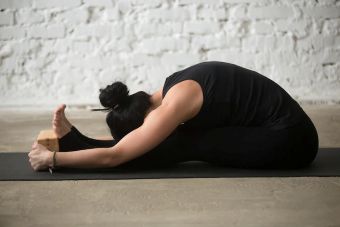
Faulty postures & sedentary lifestyle contribute to weakening of core muscles & increased incidence of musculoskeletal disorders.
Of late it is very common and spine curvature and instability leads to constant strain and pain back as well as limbs. On this back drop, the inevitability of strengthening core muscles is enhancing day by day. More people needs to be aware about core muscle strengthening yoga and other exercises to avoid any musculoskeletal disabilities arising in future.
What is meant by core muscles?
The “core” muscular network means the lumbo-pelvic-hip complex. The core muscle can also influence hamstring muscle functions.
Core stability is defined as the ability to control the position and motion of the trunk over the pelvis to allow optimum production, transfer and control of force and motion to the terminal segment in integrated athletic activities.
Activation of specific core muscle are involved in asanas or yoga poses which depended on trunk and pelvic movements.
Core muscle activity is best understood as the pre-programmed integration of local, single-joint muscles and multi-joint muscles to provide stability and produce motion. This results in proximal stability for distal mobility, a proximal to distal patterning of generation of force, and the creation of interactive moments that move and protect distal joints.
Evaluation of the core should be dynamic, and include evaluation of the specific functions (trunk control over the planted leg) and directions of motions (three-planar activity).
Rehabilitation should include the restoring of the core itself, but also include the core as the base for extremity function.
Computer -desk sitting syndrome & impact on spine &pelvis
Shortening of hamstrings occurs from continuous sitting. Shortened hamstrings have a negative effect on mobility of the pelvis and the lumbar spine.
During the practice of Utthanasana, rectus abdominis muscle flexes the trunk forward, which is further accentuated by iliopsoas and quadriceps.
Core muscles of back – Erector spinae [ES] & multifidus [MS ] in yoga poses
The back muscles of the core include ES and multifidus (MF)
- ES is a group of posterior spinal muscle which is continuous from the sacrum to the occiput, and together they are involved in vertebral extension.
The ES muscle groups are categorized from head to sacrum as capitis, cervicis, thoracis, and lumborum. The thoracis and lumborum parts of the ES form the posterior aspect of the core.
Tadasana causes contraction of these muscles causing the spine to straighten.
Utthita Trikonasana contracts the laterally placed LT and IC causing lateral bending of spine. The forward bends, such as Uttanasana, stretch these muscles and the backbends (Bhujangasana) strengthen these muscles.
Back muscle activation pattern of ES is prominently higher in Utthanasana, Urdhva Mukha Utthanasana, Urdhva Mukha Svanasana, Virabhadrasana (nondominant), and Virabhadrasana (dominant) than Adho Mukha Svanasana[3].
- Multifidus &yoga
MF muscle activity increased in ipsilateral bridge pose and contralateral bridge postures. The purpose of this study was to investigate both relative (as a percentage of maximal voluntary isometric contraction) muscle activity levels and ratios of local to global muscle activity, during bridging stabilization exercises[5]. Bridging exercises, all back muscles contribute in a similar way to control spine positions and movements in a healthy population.
- Quadratus lumborum (QL)
Deep to the ES, lies the quadratus lumborum (QL) which originate from the posterior iliac crest and inserts on the lower border of 12th rib and transverse process of lumbar vertebra 1 through 4.
Contraction of the QL unilaterally flexes the trunk to the side in Utthita Trikonasana. Urdhva Dhanurasana contracts the QL which extends the lumbar spine.
The functional shortening of QL is associated with sedentary lifestyle postures, and it limits the range of flexion in lumbar vertebra. Shortening of QL increases lumbar lordosis which is reflected as functional stiffness of the lower back and a lack of up- and down-flow of movement. It becomes difficult to raise the pelvis off the ground and rounding the back. This is important for standing in an erect posture.
Ability to perform back-bending posture is an indicator of healthy core musculature.
Variations in core muscle firing patterns depend on the trunk and pelvic positions during these poses.
Training programs can be developed by choosing particular poses to target specific core muscles for addressing low back pain and declines in performance.
The High plank, Low plank and Downward facing dog poses are effective for strengthening external oblique abdominis, Chair and Warrior 1 poses for targeting gluteus maximum, and Chair and Halfway lift poses for strengthening longissimus thoracis. And these three muscles could be strengthened by the Upward facing dog pose.
written by dr sanjana p souparnika
References
- Richardson C, Jull G, Hodges P, Hides J. Therapeutic Exercise for Spinal Segmental Stabilization in Low Back Pain: Scientific Basis and Clinical Approach. New York: Churchill Livingstone; 1999. [Google Schola
- https://pubmed.ncbi.nlm.nih.gov/16526831/
- https://pubmed.ncbi.nlm.nih.gov/24731894/
- https://www.ncbi.nlm.nih.gov/pmc/articles/PMC5433114/
- https://pubmed.ncbi.nlm.nih.gov/16987410/
- https://pubmed.ncbi.nlm.nih.gov/24731894/