

Lumbar Radiculopathy is a lower backpain and weakness associated with nerve root compression. This article deals with solutions to reduce its impact.
Lumbar radiculopathy- Lower back pain

Lumbar radiculopathy refers to pain in lower back, precisely in the lumbar region and down the back to the thighs and legs from a pinched or irritated nerve root in the lower back or spine.
The term ‘lumbar’ means the lower back region of the body, specifically the five large vertebrae (L1 to L5), the spinal discs, and the surrounding muscles. The term radiculopathy refers to a condition caused by the compression, irritation, or inflammation of a nerve root near the spine that may lead to pain, numbness, tingling, or muscle weakness on the nerve pathway.
The pain may be sharp, electric, or burning in nature often accompanied by numbness, tingling, or weakness.
The nerve root irritation in this condition can happen from several causes. A few are listed below.
Causes of lumbar radiculopathy
- Herniated disc
- Spinal stenosis
- Spondylolisthesis
- Nerve root injury
- Degenerative disc diseases
- Genetic defect
Radiculopathy happens from mild to severe causes ranging from disc bulging or herniation, facet or ligamentous hypertrophy in the nearby area of lumbar spine, spondylolisthesis to cancers and infections.
Herniated disc: it is a common condition in the lower back or lumbar region. The discs forming the vertebral column may leak after disruption and the soft material may cause inflammatory reaction in the area irritating the nearby nerve roots and may also cause compressive force over it.
According to a study degenerative spondyloarthropathies are the primary cause of lumbar radiculopathy which occur with ageing.
It can happen from age related changes on vertebra such as bone spurs or osteophytes.
Spinal stenosis is yet another cause of radiculopathy. It happens from narrowing of the spinal canal or the openings where nerves exit out of foraminal openings of the spine.
Spondylolisthesis: This is a condition that happens when one vertebra slips forward over another, it compresses the nerve roots.
Traumatic nerve injury
Nerve root injury from trauma and fall is yet another cause associated with fracture.
Apart from trauma, age itself is a risk factor for degenerative changes in the disc and affects both men and women. Mostly men are affected in their 40s and women after 50s and 60s, however, nowadays it is affecting younger women also. Of late there has been a surge in lumbar radiculopathy cases.
Symptoms
Pain radiates down the thigh, leg, and into the top of the foot or big toe. The location or area of pain distribution depends on the nerve root affected in the lumbar region or below that[L1-L5].
Irritation of nerve roots at specific levels (most commonly L5 and S1) causes the classic pain that shoots down the back or side of the leg. Pain travels down the back of the thigh, calf, and into the outer edge of the foot. This pain is often referred to as sciatica.
You may feel weakness when trying to push off the foot while walking.
Pathology of lumbar radiculopathy or nerve root pain
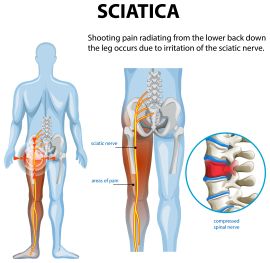
Mostly the pain in these kinds of nerve pains of spine irritation of a particular nerve happen at any point along the nerve due to a compressive force. Precisely, in case of lumbar radiculopathy [ or lower back pain from compressive forces] this may occur within the thecal sac or as the nerve root exiting the thecal sac within the lateral recess or as the nerve root passes the neural foramina or even after the nerve root emerged out of the foramina. Compression of nerve root is the major cause of pain in other areas of the body, particularly on lower limb and back.
Diagnosis of lumbar radiculopathy
History taking, physical examination and imaging study investigations conjointly help to arrive at the exact cause of pain.
Sometimes investigations or image studies such as MRI or CT-myelogram are performed to find out the nerve impingement or area of compression. The clinical symptoms in the patient and physical examination findings are correlated with these findings to arrive at a diagnosis.
Electromyography (EMG) and nerve conduction velocities (NCV), as well as somatosensory evoked potentials (SSEP) may help to differentiate other causes of nerve entrapment pain from radiculopathy.
Treatment options
- Conservative treatment focuses on pain management with medications:
Non-steroidal anti-inflammatory drugs or nerve pain reducing drugs are suggested by conventional medicine
Epidural steroid injections can provide temporary but significant relief by targeting the inflammation around the nerve root
- Physical therapy- stretches and some exercises to reduce pain and inflammation. McKenzie exercises has been found to be effective in reducing pain from lumbar radiculopathy
- Surgery– It is indicated in cases which are not manageable by conservative methods.
- Homeopathic medications
Following medications are commonly used for managing pain and allied symptoms of lumbar radiculopathy:
- Hypericum perfoliatum
- Rhus Toxicodendron
- Colocynthis
- Magnesium phosphoricum
- Magnesium carbonicum
- Kali iodide
- Valeriana
- A few “mother tinctures” [liquid drops] also are indicated as short acting drugs for managing nerve pain.
- Homeopathic medicines are selected in an individualized way after comprehensive case taking and physical examination and evaluating the investigative findings. Apart from these common drugs deep acting “constitutional drugs” are chosen tailoring to individual symptoms and characteristic.
- Yoga & nutrition also have key role in strengthening spine .In mediprecision clinic we focus on integrating the medications with these Yogic nutrition therapy.
Warning signs for seeking urgent or emergency medical care
When you experience any of these symptoms, please seek emergency care in a well-equipped hospital with facility to do decompression surgery:
- Sudden weakness in legs
- Loss of bowel or bladder control.
- Numbness in groin or saddle anaesthesia in private parts perineum. All these symptoms point to a condition called cauda equina syndrome which requires immediate decompression.
Author- dr Sanjana p
References
- https://pubmed.ncbi.nlm.nih.gov/17445735/ Tarulli AW, Raynor EM. Lumbosacral radiculopathy. Neurol Clin. 2007 May;25(2):387-405. doi: 10.1016/j.ncl.2007.01.008. PMID: 17445735.